Windows Live Mail For Windows 10 64 Bit Download
 | |
| Screenshot Windows Live Messenger, c. 2011 | |
| Other names | MSN Messenger |
|---|---|
| Programmer(southward) | Microsoft |
| Initial release | July 22, 1999 (1999-07-22) |
| Final release | 2012 (v16.iv.3508.205) (August 7, 2012 (2012-08-07)) [±] |
| Operating system |
|
| Successor | Skype |
| Available in | 50 languages |
| Type | Instant messaging |
| License | Proprietary (Freeware or bundled) |
| Website | messenger |

MSN Messenger (also known colloquially only as "MSN"[1] [2]), later on rebranded as Windows Live Messenger, was a cross-platform instant-messaging customer developed by Microsoft.[3] It connected to the Microsoft Messenger service and, in afterward versions, was compatible with Yahoo! Messenger and Facebook Messenger. Versions were developed for Windows, Xbox 360, Mac OS X (later under the name Microsoft Messenger for Mac), BlackBerry Bone, iOS, Coffee ME, S60 on Symbian Bone 9.x, MSN TV, Zune HD,[4] Windows Phone, Windows Mobile and Windows CE.
The client was first released as MSN Messenger Service on July 22, 1999, and was marketed under the MSN brand until 2005, when it was rebranded nether the Windows Live proper noun. It has since been officially known past the latter proper name, although its kickoff name remained in common utilize.[5] [6] In June 2009, Microsoft reported the service attracted over 330 1000000 active users each calendar month, placing it amidst the near widely used instant-messaging clients in the world.[7]
Following its acquisition of Skype Technologies in May 2011, Microsoft added interoperability between Skype and Microsoft accounts, allowing Skype—which had features unique to its platform and a wider user base of operations—to communicate with Windows Live Messenger contacts. In 2013, the production was discontinued, and Microsoft began cutting service to existing clients. It remained active in Communist china for another 18 months, and ceased operations there on October 31, 2014.
History [edit]
MSN Messenger 1.0–7.5 (1999–2005) [edit]

MSN Messenger logo, 1999–2006

Before the product was renamed Windows Alive Messenger, information technology was named "MSN Messenger" from 1999 to 2006. During that time, Microsoft released seven major versions as follows. The starting time version of MSN Messenger Service, version i.0 (1.0.0863), was released July 22, 1999. It included only basic features, such as plain text messaging and a simplistic contact listing.[8] When it was starting time released, it featured support for access to America Online's AIM network. America Online continually tried to block Microsoft from having access to their service until eventually the characteristic was removed, and information technology has not re-surfaced in whatsoever later versions of the software.[9] AOL did this by exploiting a buffer overflow bug in AIM, which causes it to execute a flake of automobile code sent by the server. When this code runs, it determines if the client is AIM and sends a message back to verify the client.[x] Since then, the software has only allowed connections to its ain service, requiring a Windows Live ID (.Cyberspace Passport at that time) account to connect. Microsoft released the first major update, version 2.0 (2.0.0083), on November 16, 1999. It included a rotating advertising banner and the ability to customize the appearance of the chat window. It came as an install option for Windows Me. This version was followed the next year by version 3.0 (three.0.0080), which was released May 29, 2000. It included file transfers and PC-to-PC and PC-to-phone sound capabilities with Net2Phone and Callserve,[11] 2 of the larger VoIP providers.[12]
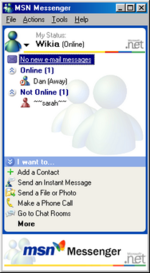
Forth with the release of Windows XP came version 4.6 of MSN Messenger, on October 23, 2001. It included major changes to the user interface, the ability to grouping contacts, and support for voice conversations.[13] In this version, the customer software was renamed from "MSN Messenger Service" to just "MSN Messenger," while the underlying service became known as ".Net Messenger Service". This version was only compatible with Windows 95, 98, ME, NT 4.0, and 2000, because Microsoft provided a scaled-downwards new program for Windows XP, called Windows Messenger. Version 5.0 of MSN Messenger was released on October 24, 2002. It was the first version that was allowed to exist installed along with Windows Messenger on Windows XP.[14] It included UPnP (Universal Plug and Play) based file transfers, minor changes to the user interface artwork, and a Windows Media Player interface plug-in.[xv]
Version vi.0 of MSN Messenger was released July 17, 2003. MSN Messenger 6.0 was a major overhaul of the whole platform, upgrading its simple text-based interface to include customizable elements such as emoticons, personalized avatars, and backgrounds. An update, version half dozen.1, focused on improvements to the conversation window, enabling users to hide the window frame and bill of fare bar, and also the ability to change the theme color. The theme color could be set differently for each user. Another update, version six.ii, was released April 22, 2004, and it was the last version of the MSN Messenger 6 serial. The near notable changes were a dedicated Mobile group for mobile contacts, a connexion troubleshooter, and the Launch Site feature was renamed to Fun & Games.
MSN Messenger received a major upgrade to version 7.0 on April 7, 2005. This version brought flash features that were previously just available in threedegrees. This version too advertised items to sell to yous including blithe display pictures, emoticons and backgrounds. The contact list window style was also updated to lucifer instant bulletin windows. This version also introduced the Xbox Alive Integration feature. This version likewise introduced digital ink and handwriting recognition back up. It is the last version of MSN Messenger to back up Windows 98, Windows Me and Windows 2000.
The last version of MSN Messenger before the proper name change, version 7.5, was released August 23, 2005. New features included the Dynamic Backgrounds feature and the "msnim" protocol handler, which immune Web sites to provide links which automatically add a contact or start conversations. Additionally, a new Voice Clips feature allowed users to concord down F2 and record a message for a maximum of 15 seconds and transport it to the recipient. The window for conversations was changed slightly with an added video push button. This version also introduced the Windows Installer for its car-update feature.[16]
Windows Live Messenger 8.0–8.5 (2005–2009) [edit]

Windows Live Messenger viii.0
As part of Microsoft'southward Windows Live effort, which rebranded many existing MSN services and programs, MSN Messenger was renamed "Windows Alive Messenger" first with version 8.0.
The first beta of the newly renamed Windows Live Messenger, Beta 1, was released on December 13, 2005.[six] Major changes and additions included offline messaging, an option to change the color theme of the windows, separated send and search boxes, a word cycle search box in the main window, and boosted details for contacts when hovering over their names in the contact list window.
The second beta of version 8.0, Beta 2, was released on February 26, 2006.[6] The overall theme of this version was improved, fixing and improving several smaller places in the program. Major changes and additions included the introduction of Windows Live Contacts, the reintroduction of single file transfer, improvements to the "Add a Contact" dialog box, improved colour themes, minor changes in the conversation window, and revert of the "Busy" status icon back to the normal nuance icon.[17]
The concluding beta version, Beta 3, was released on May 2, 2006.[half dozen] Major changes and additions included new icons for the plan, PC-to-phone calling, an updated look for the Windows Live Phone call window, a new default display picture, the Windows Alive Today window, improvements to the grouping of sequential messages from each contact, Rhapsody integration in the U.S., and an option for sounds to be edited and/or turned off.[18]
The official release of Windows Live Messenger version 8.0 was on June nineteen, 2006.[6] Although no notable changes were made between Beta 3 and the concluding version,[19] the change from MSN Messenger to Windows Alive Messenger brought some additional changes, such as customization for the nicknames of private contacts, timestamps on messages, the ability to see a contact's name merely once if the same person writes multiple messages in a row, and colour schemes for the entire application. The main hallmark organisation, Microsoft Passport Network, was replaced with Windows Live ID at the aforementioned fourth dimension. A refresh to version 8.0 was released on August ten, 2006.[6] It included audio and video improvements and fixed up pocket-size bugs.[xx]
The first update to Windows Live Messenger was previewed on October 30, 2006, with the release of Beta ane of version 8.1.[6] No major changes were fabricated, but several modest changes were included. These include the add-on of the roaming identity characteristic (and then that the same user'south display proper noun and picture show would appear on any figurer), a new contact bill of fare appearance, a "recently used" list for the emoticon, flash, display picture and background menus, an SMS phone volume in the primary menu allowing the association and editing of a phone number to the contact and allowing text messaging to a contact, a "sign out" push button, a "study abuse" option in the help carte, interoperability with Yahoo! Messenger, and improvements to user status on Windows Vista[21]
A minor update, the Windows Live Messenger 8.1 Beta ane Refresh, was released on December 13, 2006,[vi] and stock-still bugs that were causing some people to exist unable to sign in and others unable to see their contact list.[22]
The final version viii.1 was released on January 29, 2007.[six] No changes were fabricated from the Beta 1 Refresh.[23] All versions of Windows Live Messenger below version 8.one were rendered obsolete on September 12, 2007, due to a security issue identified when a user accepts a webcam or video chat invitation from an attacker.[24]
On September 12, 2007, the Windows Alive Messenger web log posted a gear up that resolved a security problem. It reported of a security vulnerability in versions of Messenger older than 8.1, that the released set would resolve. This led to an auto-update being released to all older versions. Versions running on Windows 2000 and below were required to update to a new version of MSN Messenger 7.0, and versions running on Windows XP and above were required to update to Windows Live Messenger 8.1.[24]
On August 27, 2009, the Windows Live Messenger weblog posted that due to a security problem, all users of versions 8.1 and newer demand to update to the latest version, 14.0.8089. The mandatory upgrade requirement would exist fully phased in by late October 2009 and began on September 15, 2009.
The offset beta of Windows Live Messenger 8.5, Beta 1, was released on May 31, 2007.[6] An update was released on June 21, 2007, to test updates being installed past Microsoft Update. This version required Windows XP SP2, compared to previous versions requiring Windows XP SP1. Information technology was the first version to exist installed in a "Windows Live" folder under "Programme Files," with the shortcuts placed in a "Windows Alive" folder in the Starting time Card.
Major changes and additions in Beta 1 included a new installation plan in conjunction with the release of Windows Live 2.0, a new look for all of its windows that matches the aesthetic styles of Windows Vista,[25] a new "bunny" emoticon,[26] and integration with Windows Live OneCare Family unit Safety.[27] Beginning with this version, updates could be downloaded and installed through Microsoft Update.
The second beta of Windows Live Messenger viii.v, Beta 2, was released on September five, 2007.[28] Several bug were stock-still in Beta 2, but no significant changes were practical. Compared with the first beta, the build does non say "Beta" on the peak of the window, although developers had noted that it was not the last release. The new Windows Live Installer, which is used to install Windows Live Messenger eight.5 Beta ii, does not run on Windows Server 2003.
The final release of Windows Alive Messenger version 8.five was released on November vi, 2007, and it introduced no major changes.[29]
Windows Live Messenger 14.0–16.4 (2009–2012) [edit]
Windows Alive Messenger 2009 was originally designated version 9.0, information technology was later assigned the technical version number 14.0, in society to be unified with the other Windows Live programs and Microsoft Office programs.
In a presentation to the Georgia Institute of Technology'due south IEEE Student Co-operative, Microsoft employee Andrew Jenks reported that the Messenger squad had been working on multi-person audio/video conversation, and they are also attempting to create interoperability with AIM/XMPP/ICQ. There is a basic internal version that works with XMPP already.[30] However, these features were not seen in whatever versions of Windows Live Messenger 2009.
Microsoft sent an invitation to participate in the Windows Live Messenger "9" beta program to Microsoft Connect members on November 20, 2007; a week later on, Microsoft began sending out emails welcoming them to the Windows Live Messenger "9" beta program for the first release, known as Beta 0.
A fan site for Windows Alive Messenger, Mess.be, claimed to have a new build of Windows Live Messenger "ix" on August xi, 2008, and published screenshots along with a brief summary of new features. The screenshots featured a new user interface blueprint matching the "Wave iii" design in development by Microsoft. The images were afterwards removed by the site after a DMCA detect was received.[31] The installer for the same build was leaked through individual forums on August 23, 2008. Information technology would later be discovered this build was a preview of Milestone ii, or M2.
News web site LiveSide published an commodity on September 4, 2008, with screenshots of M2 of the newly minted "Windows Live Messenger 2009," which had become version fourteen.0 instead of ix.0 equally previously expected. LiveSide summarized its new features, including protection against messaging spam, the ability to stay signed into the awarding from several computers (referred to as "Multiple Points of Presence Support"), animated GIF files in the photograph area, per-contact customized sounds for diverse user actions, and clickable URLs in the status area.[32]
Microsoft began the official beta plan for Windows Live Messenger 2009 on September 17, 2008, when it released a new beta officially known as Windows Alive Messenger 2009 Beta (Milestone three, Build 14.0.5027.908), which was made bachelor to the full general public equally a free download. The ability to submit feedback, however, was restricted to select participants of the Microsoft Connect closed beta programme.
Notable changes in Milestone three include a new revamped and refined user interface to follow adjust with the rest of the Windows Live "Wave iii" design, the power to set up a "Scene" past customizing the groundwork image and colour of the contact list, and the brandish of these scenes in conversation windows for improved contact identification and window management.
Milestone 3 too brings a new "Groups" characteristic that allows users to create a continuous group conversation between select contacts, newly redesigned status icons which now resemble small gems rather than the previous "Messenger Buddy" icons, a new default "Favorites" category in which you can place your favorite contacts for piece of cake access to them, a new Photo Sharing utility that allows contacts to apace and easily browse photos together, and a "What's New" department at the bottom of the contact listing to outline recent contact updates. Display pictures accept been moved over to the left side of chat windows, and new colorful borders appear effectually display pictures to display the current status of that contact. Milestone iii is the beginning version of Windows Alive Messenger to use the standard window frame on Windows Vista in accord with the user feel guidelines.
Several features were removed in version 9.0 nonetheless, such as the power to employ add-ins, the ability to transfer files when the recipient is signed in equally offline, the "Exist correct back," "Out to luncheon," and "In a call" status options,[33] the Become to my space button, the ability to adapt webcam settings during a video phone call, the Send push,[34] some games (depending on your localization) and integration with Windows Contacts.[35] Other features were replaced, such as Sharing Folders [36] (replaced by integration with Windows Live SkyDrive) and background sharing (replaced by the "Scene" feature).
On Dec xv, 2008, Windows Live Messenger 2009 RC (Build fourteen.0.8050.1202) was released together with the other Windows Alive Wave 3 software applications, now renamed as Windows Live Essentials.[37] This version saw a removal of the custom sign-in sound feature however it is nevertheless possible to select a sound for other individuals, equally well equally changes to how the background paradigm chosen is applied to the conversation windows. This build as well included over 200 bug fixes including the "Custom Emoticon Issues" and saving of pictures when using the Photo sharing characteristic. On January seven, 2009, the aforementioned build was released as the final version of Windows Alive Messenger 2009.[38]
The final QFE update for Wave three was released on May 12, 2010, and saw the removal of some features from Windows Live Messenger. Specifically, the power to independently evidence only your own webcam or your contacts' webcam (one fashion webcam) and without an sound call is gone.[39] It is just possible to offset a video call which starts the webcams of both people communicating and which also automatically starts audio calling. Also removed is the ability to import and salve/export instant messaging contacts to and from .CTT files.[twoscore]
On June 14, 2012, Microsoft has made the update from 2009 to 2011 mandatory for those using Windows Vista or 7. 2009 continues to be usable for those still running XP.[41] This can exist circumvented past running Windows Alive Messenger in Windows XP compatibility mode, thus making it believe it is running on Windows XP.[42]
In belatedly March 2010, a beta of Windows Alive Essentials Wave iv was leaked onto the net and has since spread to various BitTorrent networks, which included a private beta build of Windows Live Messenger Moving ridge 4. Nonetheless, as the software was designed for individual beta testing, non-beta testers cannot sign into this leaked build.[43]
The new software features a revamped interface which brings the "What's new" section of Windows Live to the new "social pane", similar to the fashion a social networking site presents updates. Among the new features are tabbed conversations, a redesign of the old emoticons, integration of Bing results, congenital-in video message support, HD video conversation, in-line commenting of social updates, a new social photograph viewer that supports commenting (for Facebook and SkyDrive photos), badges back up, synchronised status updates, availability past categories, likewise as integration with Facebook conversation. However, several features had also been removed from the previous version, such as the removal of display names, handwriting tool,[44] one-style webcam requests and import/export of instant messaging contacts feature. The "Wave 4" release of Windows Alive Essentials, which includes Messenger, also dropped compatibility with Windows XP and only runs on Windows Vista or Windows seven.[45]
The new Windows Live Messenger for the iOS became available on the App Shop on June 21, 2010, in addition to other mobile versions of Windows Live Messenger for Windows Telephone, BlackBerry, and Symbian mobile platforms.[46]
On June 24, 2010, a public beta of Windows Live Messenger Wave four was released as function of the new Windows Alive Essentials beta.[47] A "beta refresh" of Windows Alive Messenger Moving ridge four was released on August 17, 2010, as function of an upgraded Windows Live Essentials beta.[48] The concluding version of Windows Live Messenger 2011 (Wave 4) was released on September 30, 2010.[49] On the same date, a version of Windows Live Messenger for Zune HD too became available.[50] [51]
On August 7, 2012, Microsoft delivered a new version of the Windows Essentials 2012 suite, which includes Windows Live Messenger 2012.[52] [53]
Discontinuation [edit]
On November 6, 2012, Microsoft announced that Messenger and Skype services would merge in the get-go quarter of 2013. Co-ordinate to Tony Bates (president of Skype Division at the time), Messenger users could sign into Skype using their Microsoft accounts, access their Messenger contacts and communicate as usual.[54] [55] On Jan 8, 2013, Microsoft emailed Messenger users and informed them that with the exception of mainland Communist china, the Messenger service would terminate working on March 15, 2013, and users would not be able to sign in.[56]
On Feb 15, 2013, ZDNet wrote the discontinuation email was simply sent to ane percent of Messenger users, a test grouping.[57] On the same twenty-four hours, Microsoft appear its plans to phase out Messenger: the process would showtime on April 8, 2013, with English language users and would end on April 30, 2013; Messenger would remain bachelor in cathay.[58] According to ZDNet, this might but employ to the ability to sign in with Messenger client; Microsoft would keep its Messenger service running for some other year.[57] "Windows Live Messenger Upgrades to Skype," as they were referred to by Microsoft, started on April 8, 2013. This transition took identify linguistic communication by language. Brazil was the last country to be "upgraded," on April xxx.
Chinese Messenger users received an email from Microsoft in Baronial 2014, containing an announcement that Messenger service in China would end on October 31, 2014; users were advised to migrate to Skype and receive free credits.[59] [60]
Features [edit]
In addition to its basic functionality and general capability every bit an instant messaging client, the latest version of Windows Live Messenger offered the following features:
Anthology Viewer [edit]
Windows Alive Messenger'due south album viewer is based on Windows Photo Gallery and provides users a photo viewing experience for photo albums shared via SkyDrive and Facebook. The album viewer is interactive and supports total screen and slideshow modes, as well as viewing and uploading comments on Facebook and SkyDrive albums. It also supports people tagging for SkyDrive. The album viewer closely resembles the Microsoft Silverlight analogue for spider web photo albums present on SkyDrive.
Announced offline to individuals or categories [edit]
Windows Live Messenger allows users to announced offline to detail individual contacts, also every bit to an entire category within Windows Alive Messenger, while appearing online to other contacts.
This is a recent feature of Windows Live Messenger 2011, and is a divergence from the previous versions of Windows Live Messenger, where blocking a contact would prevent the "blockee" from sending the user any letters to the "blocker". With the "appear offline to" configuration currently implemented, "subconscious from" users can nevertheless ship "offline messages" to the target.[61]
[edit]
Users tin connect services such every bit Facebook, MySpace and LinkedIn using Windows Live Contour, and display their contact's Messenger social updates within the "Full view" of Windows Live Messenger. Users can besides post status updates and photos directly to the connected services within Windows Live Messenger. Additionally, Messenger as well imports all contacts from the continued services and integrates with Facebook Conversation (via the XMPP protocol) for instant messaging back up with users on Facebook.
Offline messaging [edit]
Ane can ship messages to contacts who are offline; they volition receive the messages once they come online. Additionally, a user can commencement conversations even when his or her condition is set to Announced Offline in Windows Live Messenger 2009 or before.
Games and applications [edit]
There are diverse games and applications available in Windows Alive Messenger that tin can be accessed via the conversation window by clicking on the games icon, and challenging your friend or contact to a competition in a game, or inviting them to launch a shared external application.
Messenger Companion [edit]
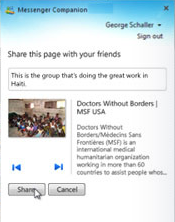
Windows Live Messenger Companion
Windows Live Messenger Companion was an add-in for Windows Internet Explorer that detects when a user is on a website that one of their friends has shared content from and surfaces that update and then that the user can instantly view what their friends take shared and leave a annotate to the shared content on Windows Alive.[62] The service utilizes Windows Alive ID and integrates tightly with Windows Live Messenger to obtain the user's contact list and their shared contents. The features of Windows Live Messenger Companion include:
- Sharing links to web pages with the user'southward friends on Windows Live within the web browser
- See links to web pages the user's friends take shared
- Add comments to the links the user'south friends have shared
Windows Live Messenger Companion was fabricated available as role of Windows Live Essentials 2011. However, Microsoft discontinued Messenger Companion in its newer Windows Essentials 2012 suite.
Protocol [edit]
Windows Alive Messenger used the Microsoft Notification Protocol (MSNP) over TCP (and optionally over HTTP to bargain with proxies) to connect to Microsoft Messenger service—a service offered on port 1863 of "messenger.hotmail.com."
The protocol is non completely secret; Microsoft disclosed version two (MSNP2) to developers in 1999 in an Internet Draft,[63] but never released versions 8 or college to the public. The Messenger service servers currently but accept protocol versions from 8 and higher, so the syntax of new commands sent from versions 8 and college is only known by using parcel sniffers like Wireshark. This has been an easy task considering – in comparison to many other modernistic instant messaging protocols, such as XMPP – the Microsoft Notification Protocol does not provide any encryption and everything can exist captured easily using packet sniffers. The lack of proper encryption also makes wiretapping friend lists and personal conversations a fiddling chore, especially in unencrypted public Wi-Fi networks.
Content filtering [edit]
The content of users' messages is filtered on server side of the client. For case, the user can't ship the links to The Pirate Bay's pages neither from the Windows Alive Messenger, nor through other clients supporting the protocol. However, links to other P2P networks are immune.[64]
"i'm" initiative [edit]
The i'k initiative was a program Microsoft launched in March 2007, that connects the user with ten organizations dedicated to social causes through Windows Live Messenger, merely for conversations sent or received in the USA. Every time someone had a conversation using i'grand, Microsoft Corp. shared a portion of the program's advertising acquirement with the organization of the user's choice. At that place was no set cap on the amount donated to each organization. The more i'm conversations the user had, the more than money went to one of the ten causes. Each participating organization was guaranteed a minimum donation of $100,000 during the first year of the program. The i'm initiative worked with version 8.ane and higher up.
In March 2010, the initiative concluded, having raised over 3 million dollars.[65]
Platforms [edit]

Messenger Mobile WAP version
Messenger Mobile (formerly named Windows Live Messenger Mobile) was the version of Messenger that was aimed to be used on mobile devices over a cellular data plan or Wi-Fi (if supported by the phone). There was also a WAP-compatible version that may exist used on any mobile device, and also specific client versions designed for Windows Mobile, iOS, BlackBerry and Nokia Series 60 devices.
Windows Mobile [edit]
A client version of Windows Alive Messenger Mobile was a part of client application named "Windows Live for Windows Mobile" included with the Windows Mobile 6 operating organisation. It was included on both Windows Mobile 6 smartphone edition (non-touch screen phones) and professional person (touch screen phones). Among other features y'all could transport vocalization-clips (max 10 seconds), pictures & emoticons.
Xbox [edit]
Windows Live Messenger support was included in the Xbox 360 spring 2007 dashboard update released on May 9, 2007.[66] Information technology was known as Xbox Live Messenger.[67]
Those using Windows Live Messenger were able to see the Gamertags of friends logged into Xbox Live, including the games that they were playing. Xbox 360 users could chat in-game or while watching a motion-picture show. Although merely text chat was supported, Microsoft suggested that voice and video chatting may come in a time to come update.[ citation needed ] Back up for child accounts was added in Dec 2007.
To coincide with the arrival of the integration of Windows Live Messenger with Xbox Alive, Microsoft released a new Xbox 360 keyboard adapter called the Xbox 360 Messenger Kit for easier text input. The keyboard device attaches to the standard Xbox 360 controller through the headphone jack and features a QWERTY-style key layout with 47 backlit keys. Yet, any USB keyboard is also uniform with the Xbox 360.
Microsoft likewise announced on June 14, 2010, that users on Xbox Live with the controller-free Kinect could have real-fourth dimension video conversations with Windows Live Messenger contacts. This feature was enabled at launch.[68]
MSN Tv set (WebTV) [edit]
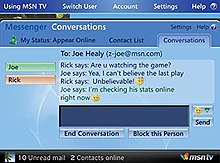
MSN Messenger on MSN TV 2
Starting in the summer of 2000, the Microsoft-owned web access product MSN TV (then known equally WebTV) introduced a software upgrade for users of its internet terminals that added a basic messaging client among other features. The messaging client was designed to piece of work with the Microsoft Messenger service and was simply named MSN Messenger.[69] The client for the original WebTV/MSN Tv cyberspace terminals supported basic presence, plain text letters (no graphical emoticons), and buddy lists, with the overall WebTV/MSN Television set service hosting services for users to add, remove, or block Messenger contacts and manage their Messenger settings. Windows Live Messenger support was later added to the MSN Goggle box 2, introducing a new UI to fit the residual of the MSN Boob tube ii's interface and support for graphical emotions. It's believed these clients still worked up until the discontinuation of the MSN TV service in September 2013.
Although WebTV was also available in Nihon well before the Summer 2000 upgrade was introduced in the U.S., information technology does not appear that Japanese WebTV users ever received this Messenger feature.
Mac [edit]
Microsoft Messenger for Mac (previously MSN Messenger for Mac) was the official Mac Bone X instant messaging customer for utilize with Microsoft Messenger service, developed by the Macintosh Business Unit, a division of Microsoft. Its feature list was limited in comparison to that of its analogue Windows Live Messenger; the customer lacked a number of features that its Windows counterpart contained.
The versions 3.x and later of Microsoft Messenger for Mac featured new Aqua graphics, whereas version ii.x and below have graphics similar to Windows Messenger 4.0. Versions 5.x used the brushed metal theme.
- Version two.v.1, update to version 2.v, which is a mandatory update to version 2.1 that is available for users running Mac Os nine.2.2.
- Version three.v for Mac Os 10 revisions older than 10.2.8
- Version four.0.one for Mac OS X revisions x.2.8 and newer
- Version five.1.1 for Mac OS 10 revisions 10.iii and newer
- Version 6.0.3 for Mac Os X revisions 10.3.9 and newer
- Version seven.0.0 for Mac OS X ten.4.9 or newer was released on April 29, 2008.
- Version 7.0.1 for Mac Os 10 ten.4 or later includes minor bug fixes.
- Version seven.0.2 for Mac Bone X 10.four or later: improves overall quality and conversations with Microsoft Office Communicator 2007 R2.
- Version 8.0.0 beta for Mac OS X 10.5 or later on, for Intel Macs only: Official Beta released on March, 24th 2010. Adds A/V conferencing between Mac Bone Ten users and Windows Live Messenger 2009 users.
- Version 8.0.0 for Mac OS X 10.5 or after, for Intel Macs only: Released with Microsoft Office 2011 for Mac in October 2010 and bears a visual similarity to previous Windows counterparts. It features somewhat more stable functional vocalization and video calls.
With the release of Microsoft Messenger for Mac 7.0, Microsoft has discontinued the client's support for older versions of their Corporate messaging systems (such as Alive Communications Server 2005).[ citation needed ] The latest version to back up these older systems is Version six.0.3, which is still available for download on the Microsoft website.
Webcam and sound support was delayed due to Windows Live Messenger's webcam and audio engine being reworked, which meant that the Mac version had to wait until this was complete in gild for both platform releases to function correctly.
iOS [edit]
The Windows Live Messenger for iOS client supported receiving of instant messaging notifications even when the application closed, and allowed Multiple Points of Presence (MPOP) such that a user can exist signed into multiple locations at the same time. Photos and albums could also be uploaded from the mobile devices onto Windows Live Photos, based on SkyDrive, and the application allowed simple prototype editing capabilities and people tagging within the photos. The awarding also supported the "Messenger social" feed on Windows Live Contour, allowing users to view and annotate on the social updates and activities of their contacts on Windows Live, likewise equally those on Facebook, MySpace and LinkedIn one time these social networks had been connected to Windows Live as a "Service".
Java ME [edit]
Nokia Series forty [edit]
The Windows Live Messenger Mobile client came as a Java ME mobile application pre-loaded on devices such as Nokia 7610, Nokia 7510, Nokia 7210, Nokia 6700c, Nokia 6600s, Nokia 6303c, Nokia 6260s, Nokia 5220, Nokia 5130XM, Nokia 3720c, Nokia 3710f, Nokia, 3600s, Nokia 2730c, Nokia 2700c, Nokia 5530, Nokia 6303c and Nokia X3.
Sony Ericsson [edit]
A version of the Windows Alive Messenger Mobile client was also pre-loaded on most Sony Ericsson mobile devices as a Java ME awarding.[70]
Symbian [edit]

A customer for Windows Live Messenger was developed by Microsoft for the Symbian S60 Platform unremarkably used on mobile phones such every bit Nokia smartphones and released on August 23, 2007, to selected markets. In May 2009, the customer was made available on the Ovi Store. This version of Windows Live Messenger included many of the features of the Windows Live Messenger client, including grouped contacts, voice clips (max 10 seconds), epitome and file sending; likewise as features unique to S60 such every bit tabbed chat windows and integration with contact list and other features of the S60 platform.[71] When the trial expires the cost to users of Messenger for S60 is £1.50/$ii.94 for 30 agenda days of use.[72] As of February 2009, Microsoft stopped charging for Windows Alive Mobile and the service is at present offered for gratuitous.[73]
Interoperability [edit]
On October 13, 2005, Yahoo! and Microsoft announced plans to add interoperability between their messenger services.[74] The declaration came later on years of third-political party interoperability success (most notably, Powwow by Tribal Voice,[75] [76] Trillian, Pidgin) and criticisms from Tribal Voice and iCast that the major real time communications services were locking their networks.[77] Yahoo! and Windows Alive Messenger became interoperable on July 12, 2006.[78] [79] For half dozen years, Yahoo! Messenger and Windows Live Messenger users in possession of upwardly-to-date software could communicate across the two networks. Instant messaging every bit well equally manual of emoticons, nudges, offline messages, presence information and personal status messages were supported.[lxxx] On December 14, 2012, the interoperability ended.[81]
Interoperability with Facebook Chat was added on September 30, 2010, with the launch of Windows Live Messenger 2011.
Run across as well [edit]
- Comparison of instant messaging clients
- Comparison of instant messaging protocols
- Microsoft Lync
- Messenger Plus! Live
- Windows Live Web Messenger
References [edit]
- ^ Billington, James (September 1, 2014). "ten things we recollect near MSN Messenger". News.com.au . Retrieved May xiii, 2020.
- ^ Basa, Eul. "30 MSN Memories Everybody Knows All Also Well". Narcity . Retrieved May thirteen, 2020.
- ^ Warren, Tom (August 29, 2014). "MSN Messenger is shutting down after 15 years of memories". The Verge . Retrieved November 14, 2021.
- ^ "Metro inspired Windows Alive Messenger defenseless on Video". 1800PocketPC. Oct iii, 2010. Archived from the original on September half-dozen, 2011.
- ^ "Microsoft Launches MSN Messenger Service". News Center. Microsoft. July 21, 1999.
- ^ a b c d e f k h i j "Lists: Releases". Within Windows Live Messenger. Microsoft. Archived from the original on February 23, 2008.
- ^ Protalinski, Emil (June 15, 2009). "Windows Live Messenger Has 330 1000000 Active Users." Ars Technica. Retrieved August 3, 2020.
- ^ Majid, Akbar (June 29, 2009). RIP: MSN Spider web Messenger, July 22, 1999 – June 30, 2009 Archived September eighteen, 2020, at the Wayback Car. merinews.com.
- ^ "AOL blocks Microsoft Net messaging". CNET News.com. [ permanent dead link ]
- ^ America Online Exploits Issues In Own Software
- ^ "Callserve registers over a one-half million Microsoft Messenger users". m2.com.
- ^ Crouch, Cameron (July 20, 2000). MSN gives Messenger a voice Archived April 17, 2012, at the Wayback Car. Networkworld.com.
- ^ Keizer, Gregg (February 26, 2002). Instant Messaging Road-Test – Messenger 4.six Archived September 4, 2009, at the Wayback Machine. ZDNet.
- ^ Wilcox, Joe (September 25, 2002). Microsoft puts a price on IM features. CNET Networks.
- ^ Flickinger, Derek R. (July 2003). Windows XP interactions with UPnP-based IDGs version 1.0. Dwelling house Toys.
- ^ "Patching". Microsoft Programmer Network.
- ^ Windows Alive Messenger 8.0 Beta 2 blog entry. Messengersays.spaces.alive.com (Feb 27, 2006). Retrieved on April 20, 2012.
- ^ Windows Live Messenger 8.0 Beta 3 weblog entry. Messengersays.spaces.live.com (May 2, 2006). Retrieved on April 20, 2012.
- ^ Windows Alive Messenger 8.0 Final release blog entry. Messengersays.spaces.live.com (June 19, 2006). Retrieved on April 20, 2012.
- ^ Windows Live Messenger viii.0 Final Refresh weblog entry. Messengersays.spaces.live.com (August 10, 2006). Retrieved on Apr 20, 2012.
- ^ Windows Live Messenger 8.1 Beta ane blog entry. Messengersays.spaces.alive.com (October thirty, 2006). Retrieved on Apr 20, 2012.
- ^ Windows Live Messenger 8.1 Beta Refresh blog entry. Messengersays.spaces.live.com (December xiii, 2006). Retrieved on April 20, 2012.
- ^ Windows Live Messenger 8.one Final blog entry. Messengersays.spaces.live.com (January 29, 2007). Retrieved on Apr 20, 2012.
- ^ a b Windows Live Messenger blog: Upgrading to 8.i. Messengersays.spaces.live.com (September 12, 2007). Retrieved on April xx, 2012.
- ^ Windows Live Messenger 8.v Beta 1 blog entry. Messengersays.spaces.live.com (May xxx, 2007). Retrieved on Apr 20, 2012.
- ^ Details about the bunny emoticon at the Windows Alive Messenger weblog. Messengersays.spaces.live.com (May xxx, 2007). Retrieved on April 20, 2012.
- ^ Windows Alive Messenger 8.five beta available from Archived June 2, 2007, at the Wayback Auto. LiveSide.net (May 30, 2007). Retrieved on April xx, 2012.
- ^ Windows Live Messenger 8.five Beta 2 weblog entry. Messengersays.spaces.live.com (September 5, 2007). Retrieved on Apr 20, 2012.
- ^ Official Windows Live Messenger team web log: Announcing Windows Live Messenger 8.5!. Messengersays.spaces.live.com (November half dozen, 2007). Retrieved on April 20, 2012.
- ^ "Messenger 9, GTalk integration, Messenger API, new client for Mac Bone X - news unveiled at Georgia Tech presentation (whew)". Liveside.cyberspace. October 31, 2007. Archived from the original on November i, 2007. Retrieved April 20, 2012.
- ^ News post at Mess.be of sectional ix.0 build. Mess.be. Retrieved on April 20, 2012.
- ^ Jeremy Kirk. "Microsoft to clamp down on spam over IM". IDG News. Retrieved November 24, 2007.
- ^ Get back the statuses which were removed from WLM 2009. Msghelp.net (Jan 13, 2009). Retrieved on Apr 20, 2012.
- ^ Unable to send typed messages – no transport button. Vistax64.com (December 29, 2008). Retrieved on April 20, 2012.
- ^ Where has the "encrypt contact list data" option gone?. Vistax64.com. Retrieved on Apr 20, 2012.
- ^ Windows Live Messenger 9.0, No Sharing Folders?. Aeroxp.org. Retrieved on April xx, 2012.
- ^ Refreshing the Windows Live Essentials beta. Windowslivewire.spaces.alive.com (December 15, 2008). Retrieved on Apr twenty, 2012.
- ^ Windows Alive Essentials is ready to download. Windowslivewire.spaces.live.com (Jan vii, 2009). Retrieved on Apr twenty, 2012.
- ^ Messenger 2009 QFE3 update removes Webcam feature and the I'g (*help) emoticon. Messengergeek.spaces.live.com. Retrieved on April 20, 2012.
- ^ Save/import of contacts also gone in latest QFE3 update of Messenger 2009. Messengergeek.spaces.alive.com. Retrieved on April 20, 2012.
- ^ R., Rudi (June 15, 2012). "Mandatory Update to Windows Live Essentials is now available". Microsoft Customs. Microsoft. Retrieved Apr 22, 2012.
- ^ "How to Disable Windows Live Messenger 2009 Force to Update". Web Talk. Jan 25, 2011. Retrieved April 22, 2013.
- ^ "Windows Live Messenger 2010 leaked: Details and screenshots inside", Messenger Stuff, archived from the original on Dec six, 2010, retrieved April 20, 2012
- ^ "Wave 4: What's New in Messenger?", LiveSide, April 28, 2010, archived from the original on May iii, 2010, retrieved May 17, 2010
- ^ "Getting set up for Windows Live Wave 4", Windows team (blog), Microsoft, retrieved April 20, 2012
- ^ Rosa Golijan (April 27, 2010). "Windows Alive Messenger iPhone App Almost Looks Better Than Desktop Version". Gizmodo. Retrieved Apr 26, 2010.
- ^ "Windows Live Preview Messenger Download". Microsoft. June 24, 2010. Archived from the original on June 22, 2010. Retrieved June 24, 2010.
- ^ Jones, Chris (Baronial 17, 2010). "Windows Live Essentials 2011 beta refresh". Microsoft. Retrieved August 17, 2010.
- ^ Jones, Chris (September 30, 2010). "Windows Live Essentials 2011 available for download at present". Retrieved February fifteen, 2011.
- ^ LeBlanc, Brandon (October one, 2010). "Windows Live Messenger for the Zune Hd". Blogging Windows. Microsoft. Retrieved August 31, 2014.
- ^ Warren, Tom (Oct 1, 2010). "Windows Live Messenger for Zune Hard disk released". Neowin . Retrieved August 31, 2014.
- ^ "Windows Essentials 2012 released, comes with new Movie Maker and Photograph Gallery". WinBeta. August 7, 2012.
- ^ Serea, Razvan (Baronial 8, 2012). "Windows Essentials 2012 (16.iv.3503.0728) released". Neowin . Retrieved Baronial 31, 2014.
- ^ Wilhelm, Alex (November 6, 2012). "Confirmed: Microsoft to retire its Messenger IM service in Q1 2013, moving 100M+ users to Skype in single act". The Side by side Web . Retrieved April 13, 2013.
- ^ Bates, Tony (November 6, 2012). "Talk to your Messenger Contacts on Skype". Skype Weblog. Microsoft. Retrieved April 13, 2013.
- ^ Protalinski, Emil (January 9, 2013). "Microsoft confirms Messenger will exist retired and users migrated to Skype on March fifteen". The Next Web . Retrieved April 13, 2013.
- ^ a b Foley, Mary Jo (April 1, 2013). "Countdown clock: Microsoft marches toward its Messenger phase-out". ZDNet. CBS Interactive. Retrieved April 13, 2013.
- ^ Munsell, Parri (February 15, 2013). "Skype and Messenger Meeting: The Next Chapter". Skype Weblog. Microsoft. Retrieved April xiii, 2013.
- ^ "MSN Messenger Is Shutting Down In Oct, 31". TechieSmith. August 31, 2014. Retrieved Baronial 31, 2014.
- ^ Xiang, Tracey (Baronial 29, 2014). "The One time-beloved Microsoft Messenger to Finally Close Down in China". TechNode . Retrieved Baronial 29, 2014.
- ^ Windows Live Messenger 2010 Beta (review), Menthix, retrieved April xx, 2012
- ^ What'southward New in Messenger: Windows Alive Reviewer's Guide. Windowslivepreview.com. Retrieved on April xx, 2012.
- ^ typhoon-movva-msn-messenger-protocol-00 – MSN Messenger Service 1.0 Protocol. Tools.ietf.org (August 31, 1999). Retrieved on April 20, 2012.
- ^ Van Der Sar, Ernesto (March 24, 2012). "Microsoft Censors Pirate Bay Links in Windows Live Messenger". TorrentFreak . Retrieved Apr 1, 2012.
Whatever Microsoft'southward reason for monitoring private conversations and then swallowing Pirate Bay links, the Redmond-based visitor'south censorship policies are not very consistent. All of the other large BitTorrent sites remain unaffected, fifty-fifty though they offer content that's identical to The Pirate Bay.
- ^ "i'm MAKING A Deviation". Windows Live website. Microsoft Corporation. June fourteen, 2010. Archived from the original on June 15, 2010. Retrieved June 15, 2010.
- ^ News on Leap 2007 Update from Xbox.com.
- ^ Support page from Xbox.com. Retrieved on Dec sixteen, 2009.
- ^ -Inside Windows Live: Connecting Windows Live Messenger and Xbox LIVE
- ^ Davenport, Dexter. "WebTV Details Upgrade: Existent G2, IM, Windows Media, More". Net4TV Voice. Archived from the original on February 27, 2002. Retrieved July 26, 2021.
- ^ "Sony Ericsson support website: Windows Live Messenger". Sonyericsson.com. Retrieved March xix, 2012.
- ^ "Nokia Europe - Windows Live". Europe.nokia.com. Archived from the original on February 28, 2009. Retrieved March 19, 2012.
- ^ Metz, Cade (January 9, 2008). "Microsoft ready to milk mobile Messenger mavens?". The Annals. Retrieved March 19, 2012.
- ^ "Nokia Europe - Frequently asked questions well-nigh Windows Live". Europe.nokia.com. Retrieved March 19, 2012.
- ^ "Yahoo and MSN marry IM services, vnunet.com, October xiii, 2005". Archived from the original on Feb 12, 2009. Retrieved June 21, 2006.
- ^ Hansen, Evan (December 10, 1999). "AOL, Tribal Voice commutation messaging blows". CNet.com. Retrieved August half-dozen, 2011.
- ^ Hu, Jim (December 4, 2000). "AOL rival drops instant messaging service". CNet.com. Retrieved August 6, 2011.
- ^ Hu, Jim (April 25, 2000). "AOL instant messaging rivals file complaint with FCC". Cnet.com. Retrieved August 6, 2011.
- ^ Yahoo Interoperability Arrives Archived July xv, 2006, at the Wayback Auto. Bigblueball.com. Retrieved on Apr 20, 2012.
- ^ Microsoft Press Release: Yahoo! and Microsoft Bridge Global Instant Messaging Communities. Microsoft.com. Retrieved on April 20, 2012.
- ^ Talk to your Yahoo! friends from Windows Live Messenger. Inside Windows Live Messenger. Microsoft. Retrieved on Dec 20, 2012.
- ^ MSN Messenger interoperability discontinuing on December fourteen. Yahoo.com. Retrieved on December 17, 2012.
DOWNLOAD HERE
Posted by: andersonsomee1984.blogspot.com
Post a Comment